We sell Steam Wallet codes, and on this particular product we are the expensive option. Our $5 card is $5.26 and our $100 card is $105.06 — roughly 5% above face value, consistently across all seven denominations, checked on our live product page on 6 September 2026.
Publishing that on a page targeting the word "cheapest" is either bad marketing or the only version of this article worth reading. We think the second, because the alternative is competing on a claim you can disprove in thirty seconds by opening the product page.
So here is the actual answer to the question, in the order that decides it.
First: if you have a working bank card, buy from Steam
Valve sells Steam Wallet funds directly at face value. $20 costs $20. No reseller — us, Bitrefill, Coinsbee, Cryptorefills or anyone else — can beat that, because we all buy from somewhere upstream and have to cover sourcing and payment costs out of the spread.
If your card works on Steam and you are simply curious whether crypto is cheaper: it is not. Close this tab and go top up directly. We would rather say that than have you discover it after paying us 5% more.
The rest of this page is for the situation where that route is closed — your bank blocks the payment, your currency is not supported, the store you need is in a different region, or your money is already on-chain and moving it into a bank costs more than the margin.
"Cheapest" is three numbers, not one
Once you are buying from a reseller with crypto, the total you pay is:
- The card price — the reseller's margin over face value.
- The network fee — what the blockchain charges to move your payment.
- Any conversion cost — if you have to swap coins first.
Most comparison pages only look at the first. On small orders, the second one is frequently larger than the first, which is why so much advice about finding the cheapest platform is beside the point.
Concretely, on our $5 Steam card:
- Our margin over face is 26 cents.
- Sending USDT on TRON or BNB Smart Chain costs a fraction of that.
- Sending the same payment on Ethereum during a busy period can cost several times the entire margin, and Bitcoin at a normal fee tier can too.
So a buyer who shops hard for the platform with the lowest sticker price and then pays on an expensive network has optimised the small number and lost on the big one. On a $5 order, choosing the network is worth more than choosing the shop. TRC20 vs ERC20 vs BEP20 is the two-minute version.
On a $100 card the arithmetic flips: 5% is $5, network fees are noise, and now the platform's margin is the whole game — so compare shops properly.
How to compare resellers honestly
The method that works, and the only one we would trust:
Open the same denomination on two sites and take both to the final confirmation screen.
Not the product page — the last screen. Margin hides in three places and only that number contains all of them: the listed price, a separate service fee line, and the exchange rate used to convert your coin. A platform advertising "no fees" may carry its entire margin in the rate. That is not dishonest, it is just not comparable until the end.
Do it on the denomination you actually want, too. Resellers do not always price every denomination at the same percentage.
Our whole price list against face value
Since we have published the Steam figure, here is the rest, from our live product pages on 6 September 2026. Prices move — the product page is the truth on the day you buy — but the pattern has been stable.
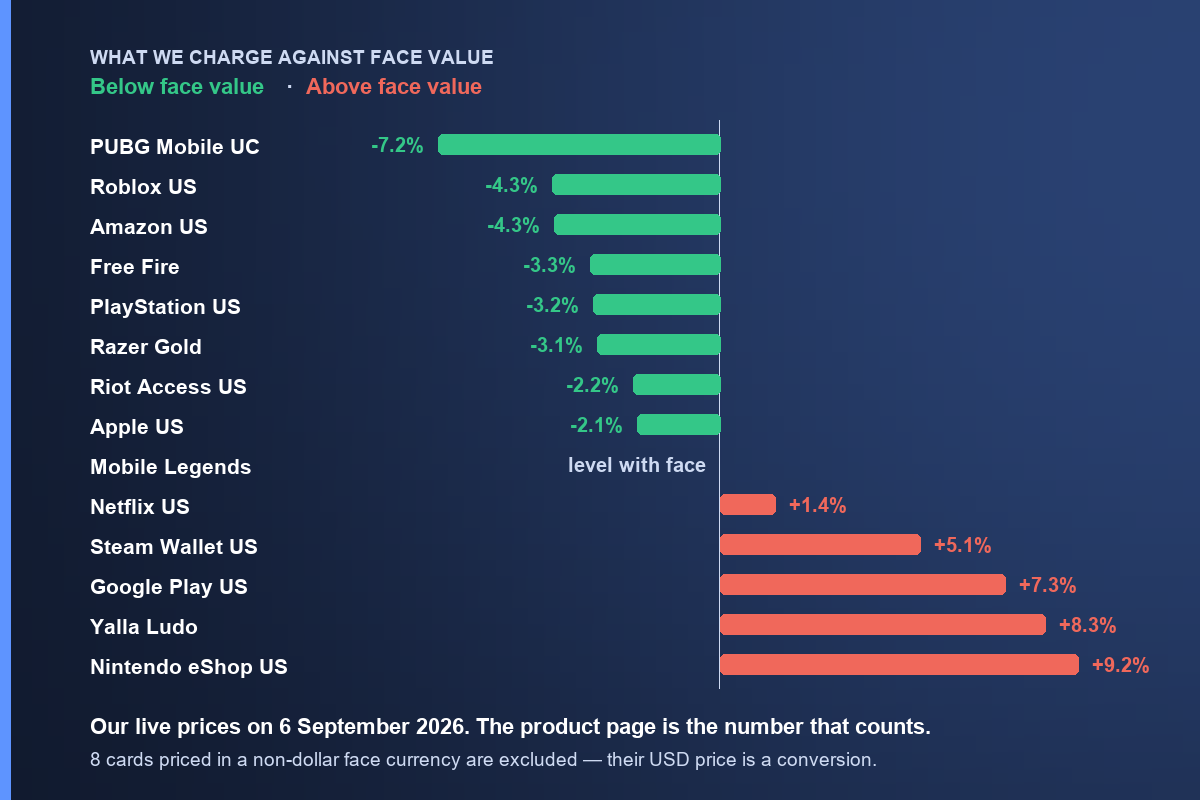
Read the green side as the discount you are getting and the red side as the premium you are paying. Steam sits on the red side, which is the whole reason this page starts where it does.
| Card | Our price vs face value |
|---|---|
| PUBG Mobile UC | about 7% below face |
| Amazon US | about 4% below |
| Roblox US | about 4% below |
| Free Fire diamonds | about 3% below |
| Razer Gold | about 3% below |
| PlayStation Store US | about 3% below |
| Apple US | about 2% below |
| Riot Access US | about 2% below |
| Mobile Legends diamonds | about level with face |
| Netflix US | about 1% above |
| Steam Wallet US | about 5% above |
| Google Play US | about 7% above |
| Yalla Ludo diamonds | about 8% above |
| Nintendo eShop US | about 9% above |
Cards priced in a non-dollar currency — Apple UK and UAE, PlayStation UK and UAE, Roblox EUR, Amazon TR, Xbox TR, Game Pass Europe — are left out on purpose. Their face value is set in another currency, so a percentage against a round dollar figure would be arithmetic rather than information.
The useful read: eight of these fourteen are below face value and five are above it. We are competitive across most of the catalogue and expensive on Steam, Google Play, Yalla Ludo and Nintendo. If Steam is what you want and your card works, see the first section. If your card does not work, then 5% is what routing around that costs here, and it is worth checking a larger platform against us before deciding.
Why is Steam the expensive one?
Because Steam Wallet is the most heavily traded gift card in this market and the wholesale supply is priced accordingly. Everybody wants it, margins upstream are thin, and nobody sourcing legitimately gets it cheap.
Which leads to the warning worth ending on.
Steam codes priced well below face are a red flag
If you find Steam Wallet codes at 20%, 30% or 40% below face, the question to ask is where they came from. Legitimate supply does not sell at a loss.
Codes at those prices are usually bought with stolen payment cards. When the chargeback lands, Valve invalidates the code — sometimes weeks later, sometimes after you have spent it, and occasionally along with action against the account that redeemed it. You have then lost the money and possibly the library.
There is no recourse, because the seller took an irreversible crypto payment and is gone. This is the one place in the gift card market where "too cheap" has a specific and predictable failure mode.
A few percent either side of face is a normal market. Thirty percent under is somebody else's fraud, with your Steam account as the exit.
Frequently asked questions
What is the genuinely cheapest way to get Steam funds?
Buying directly from Steam with a payment method that works. Every reseller sits above that, ourselves included.
Then why buy Steam Wallet with crypto at all?
Because the direct route is not open to everyone — blocked cards, unsupported currencies, or funds already held in crypto where cashing out costs more than the reseller margin. When the alternative is not buying, a few percent is a reasonable price.
How much is OnyxGift above face on Steam?
About 5%, consistently across the seven denominations from $5 to $100, as of 6 September 2026. The live product page always shows the current price.
Does the coin I pay with change the total?
Not the card price, but it changes the network fee — and on a small card that fee can exceed our entire margin. A stablecoin on a cheap network is the lowest-cost route; Ethereum or Bitcoin during congestion is the highest.
Why is a $5 card proportionally worse value?
Because fixed costs do not shrink with the order. A network fee that is trivial on $100 can be a meaningful share of $5. Buying one larger denomination rather than several small ones usually costs less overall.
Are cheap Steam codes on marketplaces safe?
Codes well below face are frequently sourced with stolen cards, and Valve invalidates them when the chargeback arrives — potentially after you have spent the balance. The price is the warning.
Which region should I buy?
The one matching the currency your Steam store displays, which is not always your country. A mismatch is rejected at redemption, and it is the most common avoidable failure on this product — see how to redeem a region-locked gift card.